
The contemporary global economy : a history since 1980 / Alfred E. Eckes.
Material type: TextSeries: History of the contemporary world: Publisher: Chichester, West Sussex ; Malden, MA : Wiley-Blackwell, 2011Description: ix, 306 pages ; 24 cmContent type: text Media type: unmediated Carrier type: volumeISBN: 9781405183437; 1405183438; 9781405183444; 1405183446Subject(s): International economic relations | Economic history | Globalization | Mondialisation | Relations économiques internationales | Histoire économique | Economic history | Globalization | International economic relations | Globalisierung | Weltwirtschaft | Wirtschaftsentwicklung | Wirtschaft | FinanzkriseDDC classification: 337 LOC classification: HF1359 | .E23 2011Online resources: Cover image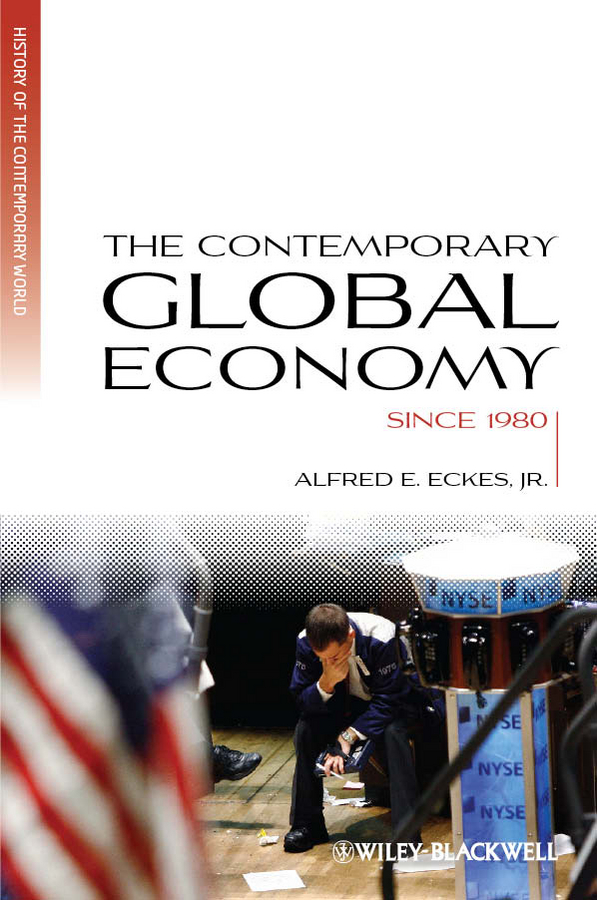
| Item type | Current library | Call number | Copy number | Status | Notes | Date due | Barcode |
|---|---|---|---|---|---|---|---|
 Books
Books
|
Female Library | HF1359 .E23 2011 (Browse shelf (Opens below)) | 1 | Available | STACKS | 51952000318996 | |
|
Books
|
Main Library | HF1359 .E23 2011 (Browse shelf (Opens below)) | 1 | Available | STACKS | 51952000318989 |
In The Contemporary Global Economy, Alfred Eckes provides an overview of recent turbulence in the world economy for non-specialists. Focusing on the dynamics of globalization since the 1980s, the book views developments historically, explaining how the main motors of economic change work and how we can discern their effects in the world today. Eckes begins with a brief description of economic change since the nineteenth century, the age of the 'first global economy', and indicates how the dramatic change in the world economy since the 1980s led to a new era in global expansion with the rise of China and other emerging powers. He explains how structural imbalances, policy mistakes, and excesses led to the financial crisis of 2007-2010. The book describes the different aspects of the economy from the role of the World Trade Organization to the workings of financial markets, and the actions of the International Monetary Fund and the Group of Twenty nations. It explains the underlying changes that have affected individuals in their various roles as consumers, producers, workers and citizens around the world, and identifies the challenges for sustainable economic growth in the years ahead. It also examines the underside of globalization, including human trafficking, sweatshops, organized crime, unsafe products, and environmental destruction.
Includes bibliographical references (pages 263-288) and index.
Introduction -- The global economy before 1980 -- The rich nations -- The developing world -- Thinking about the global economy -- International trade -- Global business -- Internationalization of Finance -- The global financial crisis of 2007-10 -- The underside of the global economy -- Epilogue.
1 2
There are no comments on this title.