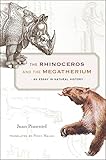
The rhinoceros and the megatherium : an essay in natural history / Juan Pimentel ; translated by Peter Mason.
Material type: TextLanguage: English Original language: Spanish Publisher: Cambridge, Massachusetts : Harvard University Press, 2017Description: 356 pages : illustrations ; 22 cmContent type: text Media type: unmediated Carrier type: volumeISBN: 9780674737129; 0674737121Uniform titles: Rinoceronte y el megaterio. English Subject(s): Rhinoceroses -- Morphology -- History | Megatherium -- Morphology -- History | Rhinoceroses in art | Megatherium -- In art | Animals and history -- Europe | Zoology -- Europe -- History | Megatherium | Panzernashorn | KulturDDC classification: 599.66/8 LOC classification: QL737.U63 | P5313 2017
| Item type | Current library | Call number | Copy number | Status | Notes | Date due | Barcode |
|---|---|---|---|---|---|---|---|
 Books
Books
|
Female Library | QL737.U63 .P5313 2017 (Browse shelf (Opens below)) | 1 | Available | STACKS | 51952000342946 | |
|
Books
|
Main Library | QL737.U63 .P5313 2017 (Browse shelf (Opens below)) | 1 | Available | STACKS | 51952000342953 |
"First published as El Rinoceronte y el Megaterio: un ensayo de morfologia historica by Abada Editores, S. L., copyright (c) 2010"--Title page verso.
One animal left India in 1515, caged in the hold of a Portuguese ship, and sailed around Africa to Lisbon--the first of its species to see Europe for more than a thousand years. The other crossed the Atlantic from South America to Madrid in 1789, its huge fossilized bones packed in crates, its species unknown. How did Europeans three centuries apart respond to these two mysterious beasts--a rhinoceros, known only from ancient texts, and a nameless monster? As Juan Pimentel explains, the reactions reflect deep intellectual changes but also the enduring power of image and imagination to shape our understanding of the natural world. We know the rhinoceros today as "Dürer's Rhinoceros," after the German artist's iconic woodcut. His portrait was inaccurate--Dürer never saw the beast and relied on conjecture, aided by a sketch from Lisbon. But the influence of his extraordinary work reflected a steady move away from ancient authority to the dissemination in print of new ideas and images. By the time the megatherium arrived in Spain, that movement had transformed science. When published drawings found their way to Paris, the great zoologist Georges Cuvier correctly deduced that the massive bones must have belonged to an extinct giant sloth. It was a pivotal moment in the discovery of the prehistoric world. The Rhinoceros and the Megatherium offers a penetrating account of two remarkable episodes in the cultural history of science and is itself a vivid example of the scientific imagination at work.-- Provided by publisher
Includes bibliographical references and index.
Prologue: Analogy and essay -- Part one. The armoured pachyderm: Itinerary -- Words -- Print -- Part two. A strange cadaver: Chimera -- Bones -- Fossil -- Epilogue: Circular lives.
1 2
There are no comments on this title.