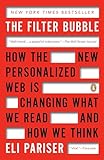
The filter bubble : how the new personalized Web is changing what we read and how we think / Eli Pariser.
Material type: TextPublisher: New York, N.Y. : Penguin Books/Penguin Press, 2012Description: 294 p. ; 20 cmISBN: 0143121235; 9780143121237 (pbk.)Other title: How the new personalized Web is changing what we read and how we thinkSubject(s): Invisible Web | Information organization | Semantic Web -- Social aspects | World Wide Web -- Subject access | Internet -- CensorshipDDC classification: 004.678 PARISER LOC classification: ZA4237 | .P37 2011
| Item type | Current library | Call number | Copy number | Status | Notes | Date due | Barcode |
|---|---|---|---|---|---|---|---|
 Books
Books
|
Female Library | ZA4237 .P37 2011 (Browse shelf (Opens below)) | 1 | Available | STACKS | 51952000168966 | |
|
Books
|
Main Library | ZA4237 .P37 2011 (Browse shelf (Opens below)) | 1 | Available | STACKS | 51952000146223 |
The race for relevance -- The user is the content -- The Adderall society -- The you loop -- The public is irrelevant -- Hello, world! -- What you want, whether you want it or not -- Escape from the city of ghettos.
A filter bubble is a term coined by internet activist Eli Pariser in his book by the same name to describe a phenomenon in which websites use algorithms to selectively guess what information a user would like to see, based on information about the user (such as location, past click behaviour and search history). As a result, websites tend to show only information which agrees with the user's past viewpoint, effectively isolating the user in a bubble that tends to exclude contrary information.
Includes bibliographical references and index.
1 2
There are no comments on this title.